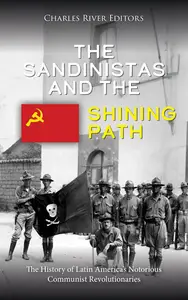
Free Download The Sandinistas and the Shining Path: The History of Latin America's Notorious Communist Revolutionaries by Charles River Editors
English | November 7, 2025 | ISBN: N/A | ASIN: B0G19NRCX9 | 122 pages | EPUB | 4.67 Mb
For much of the 20th century, Latin American governments in large part lived under a system of military junta governments. The mixture of indigenous peoples, foreign settlers and European colonial superpowers produced cultural and social imbalances into which military forces intervened as a stabilizing influence. The proactive personalities of military heads and the rigid structures of such a hierarchy guaranteed the "strong man" commanding officer an abiding presence in the form of executive dictator. Such leaders often bore the more collaborative title of "President," but the reality was, in most cases, identical. Likewise, the gap between rich and poor was often vast, and a disappearance of the middle class fed a frequent urge for revolution, reenergizing the military's intent to stop it. With no stabilizing center, the ideologies most prevalent in such conflicts alternated between a federal model of industrial and social nationalization and an equally conservative structure under privatized ownership and autocratic rule drawn from the head of a junta government.
Whichever belief system was in play for the major industrial nations of Central and South America, a constant bombardment of foreign influence pushed the people of states such as Nicaragua, Chile, Brazil, Argentina, and others toward overthrow, in one direction or the other. To the left came Stalinist influences from the Soviet Union and Castro's Cuba, while the German World War II model and an anti-communist mindset from the United States worked behind the scenes to upset any movement toward extreme liberalism. The tacit acceptance of these right-wing dictators across South America was part of an overarching effort known as Operation Condor, consisting mostly of CIA operations that are as infamous and controversial as ever, with a lasting legacy that affects current events such as reactions to the ongoing unrest in Venezuela.
Few examples remain as memorable as the conflict in Nicaragua, where the Frente Sandinista de Liberation Nacional (FSLN), a left-wing revolutionary party, seized power in the small Central American nation of Nicaragua in July 1979, toppling four decades of dictatorial rule perpetrated by the Somoza dynasty. A decade later, on February 25, 1990, in an election organized by the FSLN, one that the party was fully confident it would win, the FSLN suffered a shocking defeat at the hands of a coalition generally thought to be associated with the American-funded Contra movement. This was a sobering moment for the Latin American leftist revolution, and, as many were apt to see it, a triumph for American policy in the region.
On the evening of May 17, 1980, a day before the Peruvian electorate, the most representative in the nation's history, was due to go to the polls for the first authentic presidential election since 1963, a curious thing happened. In the tiny mountain town of Chuschi, little more than a hamlet nestled in a valley on the western slopes of the Andes, a group of armed youth broke the lock on the town hall and removed all of the ballot boxes, papers and voting lists prepared for the following day. These were carried out into the town square and burned. The group identified itself as Sendero Luminoso, the "Shining Path," declaring this action to be the commencement of the armed phase of the "People's War."
In the avalanche of press coverage for the election, the incident was scantly reported and generally overlooked. It was an exciting and energetic time in Peruvian politics, as the country sought to shake off nearly two decades of military rule and dictatorship, and a minor disturbance such as this in the rural countryside was of little interest. Nor, for that matter, was the theft of dynamite from a handful of local mines, although the handful of isolated bomb blasts that followed did stir a certain amount of curious reporting.
Code:
Bitte
Anmelden
oder
Registrieren
um Code Inhalt zu sehen!