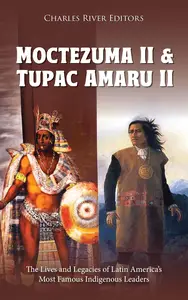
Free Download Moctezuma II and Tupac Amaru II: The Lives and Legacies of Latin America's Most Famous Indigenous Leaders by Charles River Editors
English | September 21, 2025 | ISBN: N/A | ASIN: B0FS2DFDZP | 134 pages | EPUB | 7.81 Mb
From the moment Spanish conquistador Hernan Cortés first found and confronted them, the Aztecs have fascinated the world, and they continue to hold a unique place both culturally and in pop culture. Nearly 500 years after the Spanish conquered their mighty empire, the Aztecs are often remembered today for their major capital, Tenochtitlan, as well as being fierce conquerors of the Valley of Mexico who often engaged in human sacrifice rituals.
Ironically, and unlike the Mayans, the Aztecs are not widely viewed or remembered with nuance, in part because their own leader burned extant Aztec writings and rewrote a mythologized history explaining his empire's dominance less than a century before the Spanish arrived. Naturally, Cortes and other Spaniards depicted the Aztecs as savages greatly in need of conversion to Catholicism. While the Mayans are remembered for their astronomy, numeral system, and calendar, the Aztecs have primarily been remembered in a far narrower way, despite continuing to be a source of pride to Mexicans through the centuries.
As a result, even though the Aztecs continue to interest people across the world centuries after their demise, it has fallen on archaeologists and historians to try to determine the actual history, culture, and lives of the Aztecs from the beginning to the end, relying on excavations, primary accounts, and more.
Nearly 500 years after his death and the demise of his empire, Moctezuma the Second is the most famous ruler of the most famous civilization in the New World, the Aztec. For centuries the legends surrounding his life and the conquest of the Aztecs by Hernan Cortés have fascinated readers and historians alike.
Peru and Upper Peru (what is now Bolivia) were complex colonies, the results of Spanish cultural and political domination forcibly merged with the remains of the Incan realm and indigenous religions and traditions. The Spanish language and Catholicism were also dominant, superimposed on a substrate of native people, who spoke such languages as Quechua and Aymara and quietly continued to practice aspects of traditional religions.
The Incas had consolidated their empire only a century before Pizarro and his Spanish conquistadores took control of Inca lands in the 1530s. The Incan heartland was the Andes Mountains from Ecuador down through Peru into parts of northern Chile, including what is now Bolivia, some of Argentina, and in the north, bits of what is now Colombia. It covered about 770,000 square miles, far larger than Spain, and held an estimated 14 million people, more than in Spain, comprised of many different indigenous groups.
Lima was the seat of the Viceroyalty of Peru, which included almost all of the Spanish colonial region in South America. Then, Peru meant today's Peru, Ecuador, and parts of Chile, and in the mid-18th century, a new Viceroyalty of La Plata was set up, based in what is now Buenos Aires. Upper Peru was centered on La Paz and Chuquisaca (since renamed Sucre after the hero of independence), and Peru was centered on Lima and Cuzco. The addition of La Plata as a viceroyalty refocused the necessary slow of silver from Lima and Peru to Buenos Aires and the Atlantic. The Audiencia of Charcas (Bolivia) was placed under La Plata's authority.
In one sense, the Spanish conquest was simply a shift of empires for the indigenous peoples. The Incas were as imperialistic as Spain, and they put down rebellions with the same ferocity. However, Incan rule was generally mild and concerned with the welfare of the empire's people. The indigenous people chafed under Spanish rule, and the lost Incan days were idolized in popular memory. This set the stage for one of the most famous and mythologized conflicts in the history of the Americas.
Code:
Bitte
Anmelden
oder
Registrieren
um Code Inhalt zu sehen!