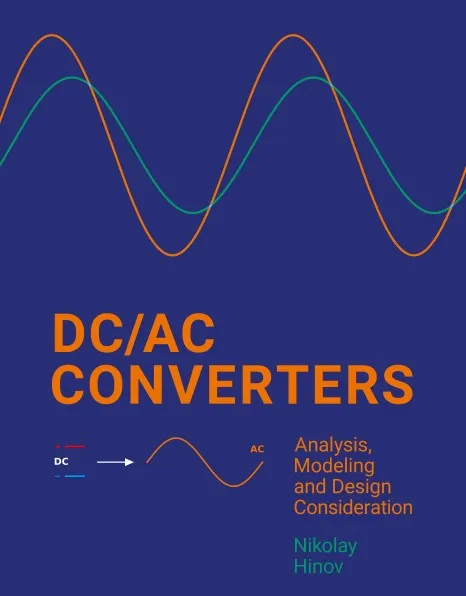
Free Download DC/AC Converters: Analysis, Modeling and Design Consideration by Nikolay Hinov
English | PDF | 2025 | 178 Pages | ISBN : N/A | 8.6 MB
This monograph presents a comprehensive and structured study of DC/AC converters, focusing on the fundamental types-current source inverters (CSIs), voltage source inverters (VSIs), and resonant inverters (RIs). The book offers a unified analytical and modeling framework, enabling detailed investigation of electromagnetic processes in inverter power circuits. A particular emphasis is placed on the development and implementation of specialized simulation models, as well as the formulation of general design methodologies applicable across a wide range of converter topologies and operating modes. The content is supported by numerous examples, diagrams, time-domain waveforms, and simulation case studies using MATLAB/Simulink and LTspice environments. The monograph integrates theory, numerical modeling, and engineering design in a coherent manner to bridge the gap between academic research and practical power electronics development. The book is intended for the following audiences:
Graduate and PhD students specializing in power electronics, electrical engineering, or related fields.
Academic researchers and teaching staff looking for a modern, structured reference in the field of DC/AC power conversion.
Engineers and system designers working on industrial applications such as electric drives, renewable energy systems, uninterruptible power supplies (UPSs), and high-frequency energy processing.
Developers interested in advanced simulation techniques and design optimization of inverter-based systems.
No prior deep knowledge in inverter modeling is required, but a solid understanding of circuit theory and power electronics principles is beneficial. The approach adopted in this book is methodologically unified, model-driven, and application-oriented. It combines the following:
Analytical modeling based on the study of electromagnetic processes in RLC equivalent circuits, suitable for all major inverter classes.
Numerical simulation, using MATLAB/Simulink and LTspice, for accurate dynamic and steady-state analysis.
Design methodology, offering step-by-step procedures to develop and optimize inverters with different topologies and operating modes.
Practical validation, through case studies and simulated experiments, ensuring a direct link between theory and engineering practice.
This hybrid approach ensures consistency, clarity, and relevance for both educational and real-world engineering environments. It is especially useful in contexts where design efficiency, model accuracy, and functional reliability are of critical importance.
[/b]
Code:
Bitte
Anmelden
oder
Registrieren
um Code Inhalt zu sehen!