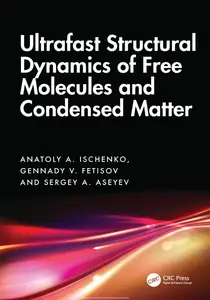
Free Download Ultrafast Structural Dynamics of Free Molecules and Condensed Matter
English | 2025 | ISBN: 1041110847 | 463 pages | True PDF,EPUB | 328.46 MB
It is the dream of every natural scientist to directly observe the motion of atoms and molecules in real time as they interact. The natural sciences by definition involve structural dynamics and the observation of molecules interconverting from one structure to another or other structures, which is, after all, the very essence of science. Each area of the natural sciences has unique intellectual goals; however, they are all united by the thought experiment in which we try to understand how molecules interconvert between different structures by passing through a reaction barrier, a transition state.
This concept of a "moment," an ultra-short time interval in the natural sciences, forces us to think about the relative positions of the atoms that define the barrier to the process of their interaction. It is the control of the barrier height that allows one of many possible atomic rearrangements to occur, since it occurs faster than competing processes. That is, the process of molecular transformation during interaction is inherently a "race against time." Manipulating the barrier height gives effective, exponential control over the yield of the reaction product. The problem of visualizing transition state structures is akin to finding a way from one valley to another in a very rugged mountainous area during an earthquake, where the mountains and the landscape change as you move across the terrain: suddenly a crack appears and the shaking takes you to a more stable valley. Without a detailed understanding of how fluctuations - in this analogy, shaking - affect the potential energy landscape, it would be difficult to guess where and when the crack will form or the path to the next valley.
At its most fundamental, chemistry is the study of structural dynamics, discussed both for synthetic purposes and for physical methods with the explicit goal of controlling the transformation of matter from one form/property to another. We now have tools to observe chemical reactions at the atomic level.
Code:
Bitte
Anmelden
oder
Registrieren
um Code Inhalt zu sehen!