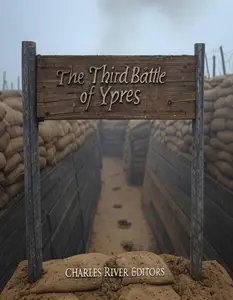
Free Download The Third Battle of Ypres: The History of the Largest Battle in Flanders during World War I by Charles River Editors
English | April 18, 2025 | ISBN: N/A | ASIN: B0F5LKNM8N | 124 pages | EPUB | 7.85 Mb
The enduring image of World War I is of men stuck in muddy trenches, and of vast armies deadlocked in a fight neither could win. It was a war of barbed wire, poison gas, and horrific losses as officers led their troops on mass charges across No Man's Land and into a hail of bullets. While these impressions are all too true, they hide the fact that trench warfare was dynamic and constantly evolving throughout the war as all armies struggled to find a way to break through the opposing lines.
Needless to say, the First World War came at an unfortunate time for those who would fight in it. After an initial period of relatively rapid maneuver during which the German forces pushing through Belgium and the French and British forces attempting to stymie them made an endless series of abortive flanking movements that extended the lines to the sea, a stalemate naturally tended to develop. The infamous trench lines soon snaked across the French and Belgian countryside, creating an essentially futile static slaughterhouse whose sinister memory remains to this day. Until the war of maneuver returned in 1918 and led to a decisive outcome for the war, the nexus of this horror lay in the rainy, sodden levels and low ridges of Flanders, near the medieval town of Ypres. In this tiny fragment of Europe, half a million men died over the course of three major battles and the times of attrition between, perishing in a squelching pit of mud, blood-tinged water, and rotting human flesh.
With the exception of a few hours on Christmas Day 1914, the shelling, sniping, raids, and bloodshed at Ypres in Belgium never ceased from the moment of first contact between the British Expeditionary Force (BEF) and the Imperial German army. The Ypres salient had formed the previous year during the "race to the sea," when the opposing armies tried and failed to outflank each other in a series of maneuvers and counter-maneuvers.
The heaviest fighting in the vicinity took place in 1917 during the Third Battle of Ypres, a linked series of battles on the Western Front that took place from July-November of that year. It is still remembered as one of the most notorious battles in British history. British troops, who called this series of battles Passchendaele after the small Belgian village that formed the final objective, continued to use the same tactics that had been employed since early 1915 as they were ordered into frontal attacks on prepared German trenches protected by artillery, barbed wire, bunkers, and machine gun positions. This took place despite the fact that in previous battles, this approach had proved utterly futile. British casualties were higher than in any previous war, and the British achieved no significant advances. The British public, previously enthusiastic supporters of a war against the German Empire, had begun to question the ability of senior British commanders and the conduct of the war in general. When the war began in August 1914, many people had predicted that it would be "over by Christmas." By 1917, a grim joke in the trenches and at home was that the war would most definitely be over by Christmas, but no one was quite certain in which year.
The Third Battle of Ypres was intended to be a war-winning campaign that would finally end the stalemate of trench warfare on the Western Front and see British and Commonwealth troops advance as far as the Belgian coast. Perhaps it might even lead to the final and complete defeat of the German Empire. The ambitions were matched only by the high casualty counts, as this series of battles would ultimately cost a quarter of a million British casualties and around 200,000 on the German side. British troops were able to advance no further than five miles, meaning the battle shifted a small portion of the front line a short distance to the east at a truly terrible cost.
Code:
Bitte
Anmelden
oder
Registrieren
um Code Inhalt zu sehen!