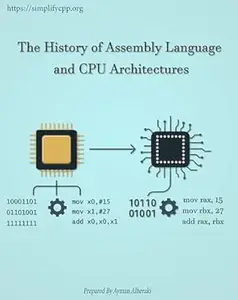
Free Download The History of Assembly Language and CPU Architectures
English | December 7, 2025 | ASIN: B0G5LFM6JX | 119 pages | Epub | 472.55 KB
For more than eight decades, Assembly language has stood at the crossroads between the human mind and the world of electronic computation. It is the first true medium through which people learned to "speak" to machines-not through wires and switches, nor through mathematical abstractions alone, but through symbolic instructions that reflect the structure and logic of the underlying hardware. This booklet was written to illuminate that extraordinary transformation. It presents a clear and comprehensive journey through the origins of Assembly language, from the earliest stored-program computers of the 1940s to the modern architectures that shape today's computing world-x86-64, ARMv8, and RISC-V. Rather than treating Assembly as a static or archaic topic, this work explores it as an evolving discipline, shaped by decades of innovation, challenges, and breakthroughs in processor design. Readers will discover: * How early computers were programmed directly in binary, and why this approach quickly became impractical. * Why Assembly emerged not as a luxury, but as a necessity for scalability, reliability, and human comprehension. * The influential roles of pioneers such as Alan Turing, John von Neumann, Maurice Wilkes, and Grace Hopper. * How Instruction Set Architectures (ISAs) evolved into distinct families: CISC, RISC, and modern hybrid designs. * How each ISA creates its own Assembly language, reflecting the philosophy and engineering decisions behind the hardware. Beyond the historical and conceptual foundation, this booklet also examines the practical side of Assembly today. It surveys the most widely used assemblers, provides clear examples across major architectures, and includes exercises designed to strengthen understanding and build hands-on skill. My goal is to present Assembly not as a relic of early computing, but as a living, essential layer of modern systems -the layer that enables operating systems, compilers, device drivers, embedded systems, and performance-critical software to exist at all. Understanding Assembly offers the reader a deeper appreciation of how computers truly operate and why software behaves the way it does. Whether you are a newcomer seeking clarity, a systems programmer aiming to reinforce your foundations, or a researcher exploring architecture and machine design, this booklet is written to guide you with precision, depth, and historical context.
Code:
Bitte
Anmelden
oder
Registrieren
um Code Inhalt zu sehen!