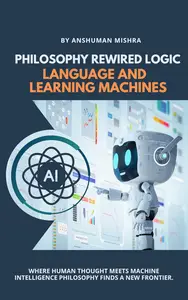
Free Download Philosophy Rewired Logic Language and Learning Machines (AI and Philosophy) by Anshuman Mishra
English | October 14, 2025 | ISBN: N/A | ASIN: B0FW6S1PZ4 | 342 pages | EPUB | 0.37 Mb
In the 21st century, the ancient questions of philosophy-about truth, logic, language, mind, and meaning-have found new expression in the digital age. Philosophy Rewired: Logic, Language, and Learning Machines explores how these timeless philosophical concerns are reshaped by artificial intelligence, machine learning, and computational logic. The book offers a deep, structured, and interdisciplinary understanding of how philosophy and computer science converge to form the intellectual foundation of modern intelligent systems.
Today's machines do not merely calculate-they reason, communicate, and learn. But do they understand? Can they know? Could they ever be conscious? These questions lie at the heart of this book. It aims to provide both philosophical clarity and computational insight into what it means for a machine to "think," "learn," or "understand," drawing connections between classical philosophical traditions and modern technologies.
This text is designed for students, researchers, and professionals from both Philosophy and Computer Science backgrounds. It invites the reader to explore how the human quest for knowledge, understanding, and consciousness is being mirrored-and transformed-by machines.
Purpose and Importance of the Book
Philosophy and computer science are often seen as distant fields-the former speculative, the latter technical. This book bridges that divide by showing that both disciplines share the same core pursuit: the understanding of thought, knowledge, reasoning, and truth.
In ancient times, philosophers such as Aristotle, Plato, Descartes, Kant, and Wittgenstein sought to explain how humans think and understand the world. In modern times, Alan Turing, John McCarthy, and Marvin Minsky used similar principles to create intelligent systems that simulate human reasoning. Philosophy gave us the questions, while computer science is now giving us the tools to explore their answers.
This book is important because it addresses the intellectual and ethical challenges of our time:What does "knowledge" mean when it is stored in algorithms?How does logic translate into machine reasoning?Can AI systems hold beliefs, make decisions, or act morally?Is consciousness possible in a computational form?What happens to human identity when intelligence is no longer uniquely human?These questions are not only academic; they are central to the way we live, work, and think in a world dominated by digital intelligence. By combining philosophy with computational models, this book allows readers to understand the logical, ethical, and metaphysical foundations of artificial intelligence.
Who Will Benefit from This Book
1. Students of Philosophy
Philosophy students will gain an understanding of how ancient philosophical concepts such as logic, mind, knowledge, meaning, and ethics have evolved into computational theories. They will learn how metaphysics meets machine learning, how epistemology guides algorithmic reasoning, and how ethics informs AI development.
2. Students of Computer Science and AI
Computer science students will discover the philosophical foundations of their discipline. They will understand why every algorithm is based on logical rules, why every intelligent system requires epistemological grounding, and how philosophical thinking can improve AI design and interpretation.
3. Researchers and Academics
For researchers, the book serves as a cross-disciplinary guide that connects epistemology, cognitive science, machine learning, and metaphysics. It offers conceptual frameworks to study AI not just as a technology but as a form of evolving rationality.
Code:
Bitte
Anmelden
oder
Registrieren
um Code Inhalt zu sehen!