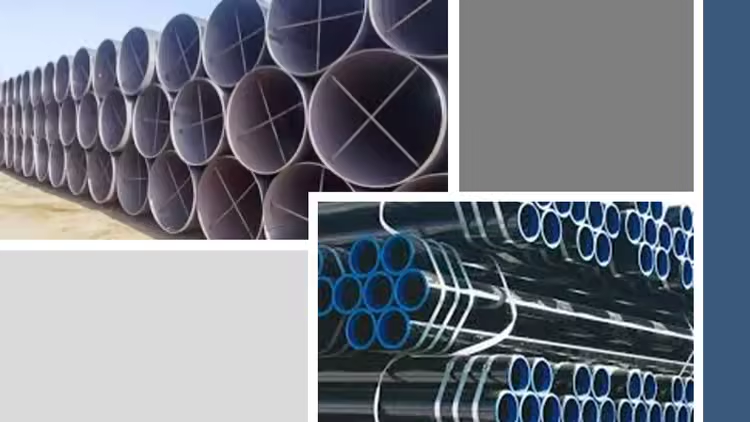
Mastering API 5L The Complete Guide to Line Pipe Spec

dkmdkm

U P L O A D E R
7ec7c4eb3da869d889c32f58c2061d4b.avif

Free Download Mastering API 5L The Complete Guide to Line Pipe Spec
Published 11/2025
MP4 | Video: h264, 1280x720 | Audio: AAC, 44.1 KHz, 2 Ch
Language: English | Duration: 38m | Size: 440 MB
Master the 46th Edition (2018), understand PSL 1 vs PSL 2, Manufacturing, NDT, Sour Service, and the Critical Errata.

What you'll learn
Distinguish Critical Levels: Confidently explain the technical differences between PSL 1 (Standard Quality) and PSL 2 (High-Requirement) line pipe.
Navigate the Standard: Efficiently locate mandatory requirements for ordering, manufacturing, and testing within the 200+ page API 5L document.
Master Acceptance Criteria: Interpret chemical composition tables, mechanical properties, and toughness limits (Charpy V-Notch & DWT).
Apply the Errata: Understand the critical May 2018 Errata update regarding Table 22 and impact test piece sizing.
Understand Manufacturing: Learn the specific rules for Steelmaking (killed steel), Welding processes (HFW, SAW, COW), and Heat Treatment.
Verify Compliance: Master the inspection frequencies, hydrostatic test pressures, and Nondestructive Testing (NDT) methods required by Annex E.
Handle Special Applications: Navigate the supplementary Annexes for high-stakes environments, including Sour Service (Annex H) and Offshore Service (Annex J).
Requirements
Basic understanding of mechanical engineering or metallurgy concepts.
Familiarity with general oil and gas terminology (helpful but not required).
No prior experience with API standards is necessary-we build from the ground up
Description
"This course contains the use of artificial intelligence."Are you a Piping Engineer, Inspector, or Procurement Specialist working in Oil & Gas?API Specification 5L is the global gold standard for the pipe used in conveying gas, water, and oil. However, with over 200 pages of technical data, complex tables, and strictly defined "Product Specification Levels" (PSL), navigating this document can be overwhelming.This course cuts through the noise.Based on the 46th Edition (April 2018) and including the crucial May 2018 Errata, this course breaks down the specification into 6 logical, digestible modules. We don't just read the code; we interpret it, showing you exactly what to look for to ensure compliance and safety.Course Breakdown:Module 1: The Fundamentals: We start with the scope, definitions, and the single most important concept in the book: the difference between PSL 1 and PSL 2. You will also learn how to structure a valid Purchase Order (PO) using Section 7.Module 2: Manufacturing: How is the pipe made? We cover steelmaking practices, permitted welding methods (HFW, SAW, COW), and the strict rules for cold expansion and heat treatment.Module 3: Acceptance Criteria: We dive deep into the numbers. You will learn how to interpret Chemical Composition tables, Tensile requirements, and Toughness testing (CVN/DWT). Crucially, we cover the Table 22 Errata update.Module 4: Inspection & NDT: Learn the rules for finding defects. We cover dimensional tolerances, surface imperfections vs. defects, and the Nondestructive Testing (NDT) methods required by Annex E.Module 5: Special Applications: Standard pipe isn't enough for extreme environments. We explore the Annexes for Sour Service (Annex H), Offshore Service (Annex J), and Manufacturing Procedure Qualification (Annex B).Module 6: Final Assessment: Test your knowledge with a guided 5-question exam covering the most common non-conformances and tricky clauses.Why take this course?Whether you are inspecting pipe at a mill, reviewing Material Test Reports (MTRs) in an office, or procuring materials for a major pipeline project, mistakes in interpreting API 5L can lead to costly rejections or catastrophic failures. This course gives you the confidence to interpret the standard correctly.Enroll today and master the language of Line Pipe.
Who this course is for
QA/QC Inspectors: Who need to perform source inspection at pipe mills.
Piping & Pipeline Engineers: Who write specifications and data sheets for projects.
Procurement Engineers: Who need to ensure they are ordering the correct materials.
Mill Metallurgists: Who need to ensure production meets the API license requirements.
Mechanical/Civil Engineering Students: Looking to specialize in the Oil & Gas sector.
Homepage
Code:
Bitte Anmelden oder Registrieren um Code Inhalt zu sehen!

Recommend Download Link Hight Speed | Please Say Thanks Keep Topic Live
Code:
Bitte Anmelden oder Registrieren um Code Inhalt zu sehen!

No Password - Links are Interchangeable
 
Kommentar

fc6854d609e56b632fc8372dfefa601d.jpg

Mastering API 5L: The Complete Guide to Line Pipe Spec
Last updated 11/2025
Duration: 38m | .MP4 1280x720 30fps(r) | AAC, 44100Hz, 2ch | 439.79 MB
Genre: eLearning | Language: English​

Master the 46th Edition (2018), understand PSL 1 vs PSL 2, Manufacturing, NDT, Sour Service, and the Critical Errata.

What you'll learn
- Distinguish Critical Levels: Confidently explain the technical differences between PSL 1 (Standard Quality) and PSL 2 (High-Requirement) line pipe.
- Navigate the Standard: Efficiently locate mandatory requirements for ordering, manufacturing, and testing within the 200+ page API 5L document.
- Master Acceptance Criteria: Interpret chemical composition tables, mechanical properties, and toughness limits (Charpy V-Notch & DWT).
- Apply the Errata: Understand the critical May 2018 Errata update regarding Table 22 and impact test piece sizing.
- Understand Manufacturing: Learn the specific rules for Steelmaking (killed steel), Welding processes (HFW, SAW, COW), and Heat Treatment.
- Verify Compliance: Master the inspection frequencies, hydrostatic test pressures, and Nondestructive Testing (NDT) methods required by Annex E.
- Handle Special Applications: Navigate the supplementary Annexes for high-stakes environments, including Sour Service (Annex H) and Offshore Service (Annex J).

Requirements
- Basic understanding of mechanical engineering or metallurgy concepts.
- Familiarity with general oil and gas terminology (helpful but not required).
- No prior experience with API standards is necessary-we build from the ground up

Description
"This course contains the use of artificial intelligence."

Are you a Piping Engineer, Inspector, or Procurement Specialist working in Oil & Gas?

API Specification 5L is the global gold standard for the pipe used in conveying gas, water, and oil. However, with over 200 pages of technical data, complex tables, and strictly defined "Product Specification Levels" (PSL), navigating this document can be overwhelming.

This course cuts through the noise.

Based on the46th Edition (April 2018)and including the crucialMay 2018 Errata, this course breaks down the specification into 6 logical, digestible modules. We don't just read the code; we interpret it, showing you exactly what to look for to ensure compliance and safety.

Course Breakdown:

Module 1: The Fundamentals:We start with the scope, definitions, and the single most important concept in the book: the difference betweenPSL 1 and PSL 2. You will also learn how to structure a valid Purchase Order (PO) using Section 7.

Module 2: Manufacturing:How is the pipe made? We cover steelmaking practices, permitted welding methods (HFW, SAW, COW), and the strict rules for cold expansion and heat treatment.

Module 3: Acceptance Criteria:We dive deep into the numbers. You will learn how to interpret Chemical Composition tables, Tensile requirements, and Toughness testing (CVN/DWT).Crucially, we cover the Table 22 Errata update.

Module 4: Inspection & NDT:Learn the rules for finding defects. We cover dimensional tolerances, surface imperfections vs. defects, and the Nondestructive Testing (NDT) methods required by Annex E.

Module 5: Special Applications:Standard pipe isn't enough for extreme environments. We explore the Annexes forSour Service (Annex H),Offshore Service (Annex J), and Manufacturing Procedure Qualification (Annex B).

Module 6: Final Assessment:Test your knowledge with a guided 5-question exam covering the most common non-conformances and tricky clauses.

Why take this course?Whether you are inspecting pipe at a mill, reviewing Material Test Reports (MTRs) in an office, or procuring materials for a major pipeline project, mistakes in interpreting API 5L can lead to costly rejections or catastrophic failures. This course gives you the confidence to interpret the standard correctly.

Enroll today and master the language of Line Pipe.

Who this course is for:
- QA/QC Inspectors: Who need to perform source inspection at pipe mills.
- Piping & Pipeline Engineers: Who write specifications and data sheets for projects.
- Procurement Engineers: Who need to ensure they are ordering the correct materials.
- Mill Metallurgists: Who need to ensure production meets the API license requirements.
- Mechanical/Civil Engineering Students: Looking to specialize in the Oil & Gas sector.
Bitte Anmelden oder Registrieren um Links zu sehen.


jpQYON0H_o.jpg


RapidGator
Code:
Bitte Anmelden oder Registrieren um Code Inhalt zu sehen!
NitroFlare
Code:
Bitte Anmelden oder Registrieren um Code Inhalt zu sehen!
 
Kommentar

In der Börse ist nur das Erstellen von Download-Angeboten erlaubt! Ignorierst du das, wird dein Beitrag ohne Vorwarnung gelöscht. Ein Eintrag ist offline? Dann nutze bitte den Link  Offline melden . Möchtest du stattdessen etwas zu einem Download schreiben, dann nutze den Link  Kommentieren . Beide Links findest du immer unter jedem Eintrag/Download.

Data-Load.me | Data-Load.ing | Data-Load.to | Data-Load.in

Auf Data-Load.me findest du Links zu kostenlosen Downloads für Filme, Serien, Dokumentationen, Anime, Animation & Zeichentrick, Audio / Musik, Software und Dokumente / Ebooks / Zeitschriften. Wir sind deine Boerse für kostenlose Downloads!

Ist Data-Load legal?

Data-Load ist nicht illegal. Es werden keine zum Download angebotene Inhalte auf den Servern von Data-Load gespeichert.
Oben Unten