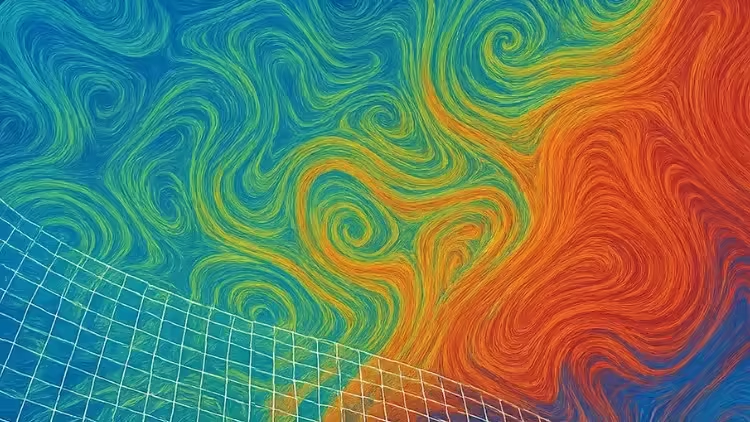
Free Download Introduction to RANS Turbulence Modeling in OpenFOAM
Published 12/2025
MP4 | Video: h264, 1920x1080 | Audio: AAC, 44.1 KHz, 2 Ch
Language: English | Duration: 1h 54m | Size: 1.32 GB
Eddy-Viscosity Models and the Backward-Facing Step
What you'll learn
Describe the Reynolds-Averaged Navier-Stokes equations, the concept of Reynolds stresses, and the need for turbulence modeling.
Explain the Boussinesq hypothesis and how eddy-viscosity-based models close the RANS equations.
Compare Spalart-Allmaras, standard k-ε, RNG k-ε, k-ω, and SST k-ω models in terms of assumptions, strengths, and limitations.
Justify the choice of a RANS model for separated flows such as the backward-facing step.
Configure mesh, boundary conditions, turbulence properties, and solver settings for incompressible RANS simulations.
Use ParaView to extract and interpret velocity, pressure, and turbulent viscosity fields.
Describe the key ideas behind the LRR Reynolds Stress Model (RSM) and explain how it overcomes limitations of eddy-viscosity-based RANS models.
Requirements
Ability to install and run OpenFOAM on a local machine (Linux or Docker-based setup)
Basic understanding of the Navier-Stokes equations and fundamental fluid mechanics concepts
Familiarity with CFD terminology such as velocity, pressure, boundary conditions, and meshes
Elementary knowledge of numerical methods and discretization (helpful but not mandatory)
Willingness to use the Linux command line for running simulations and post-processing
Comfortable using Ubuntu Linux for demonstrations; Windows and macOS users can follow along using Docker or WSL.
Description
This course offers a comprehensive, beginner-friendly introduction to Reynolds-Averaged Navier-Stokes (RANS) turbulence modeling using OpenFOAM, with a strong emphasis on eddy-viscosity-based models widely used in engineering CFD. The course is designed to bridge the gap between turbulence theory and practical simulation skills, making it suitable for students and early-career engineers who are new to OpenFOAM and turbulence modeling.The course begins with the fundamentals of the RANS formulation, explaining Reynolds averaging, the closure problem, and the physical meaning of turbulent stresses. Building on this foundation, learners are introduced to the eddy-viscosity hypothesis and how it leads to commonly used turbulence models. The following models are covered in detail:Spalart-Allmaras model (one-equation model)Standard k-ε modelStandard k-ω modelSST k-ω modelEach model is discussed in terms of its governing equations, underlying assumptions, near-wall treatment, strengths, and known limitations. Special attention is given to how these models behave in separated and recirculating flows, which are common in practical engineering applications.To reinforce the concepts, the course uses the backward-facing step as a canonical benchmark problem. Learners will set up the computational domain, generate meshes, specify boundary conditions, select appropriate solvers and turbulence models, and run steady-state and transient RANS simulations in OpenFOAM. Through systematic post-processing using ParaView, learners will analyze velocity fields, pressure distributions, turbulent viscosity, flow separation, and reattachment length, and compare predictions across different turbulence models.The course also emphasizes best practices in CFD, including mesh quality considerations, near-wall resolution, convergence monitoring, and basic model validation against reference data. A brief discussion on Reynolds Stress Models (RSM), including the LRR model, is included to expose learners to advanced RANS approaches and to highlight the limitations of eddy-viscosity models.To support learning, the course includes fully working OpenFOAM case files for all examples, along with additional downloadable PDF notes that consolidate all theoretical concepts, equations, and modeling details discussed in the lectures. These resources allow learners to revise the theory at their own pace and reuse the simulation setups for further practice or extension.By the end of the course, learners will have a solid practical foundation in RANS turbulence modeling with OpenFOAM and will be able to confidently apply eddy-viscosity models to real-world engineering flow problems while understanding their limitations and proper use.
Who this course is for
Undergraduate and postgraduate engineering students
Beginners in OpenFOAM
CFD enthusiasts and self-learners
Early-career CFD engineers
Researchers transitioning to OpenFOAM
Homepage
Code:
Bitte
Anmelden
oder
Registrieren
um Code Inhalt zu sehen!
Recommend Download Link Hight Speed | Please Say Thanks Keep Topic Live
Code:
Bitte
Anmelden
oder
Registrieren
um Code Inhalt zu sehen!