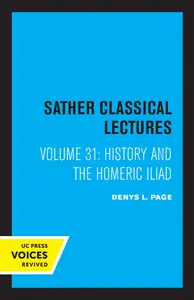
Free Download History and the Homeric Iliad (Sather Classical Lectures) by Denys L. Page
English | March 29, 2024 | ISBN: 9780520319813, 0520032462 | True EPUB | 412 pages | 6.95 MB
This title was originally published in 1959.
Professor Page's scholarship is deep and wide, a bit like the roaring torrent in Longfellow's Excelsior. One is never left in much doubt what he thinks, and L R Palmer remarks drily in Myceneans and Minoans that 'he is bolder in expression' than are professional archaeologists. To be fair, one is never left in any doubt either as to why he thinks as he does. He presents his evidence and argues his case with absolute frankness. More than that, he is a very good read, and those interested in the story of the siege of Troy and the value of the Iliad as a record of what took place will find this attractively and often amusingly written book an absorbing account of the matter, for all the paraphernalia of professional scholarship.
Denys Page was formerly professor of Greek at Cambridge, and this book constitutes, with some additions, the text of the six Sather classical lectures that he was invited to give at Berkeley in the winter of 1957. Their timing was good. The decipherment of the Linear B tablets, found both on the Peloponnese and at the Palace of Minos in Crete, had only just happened. Moreover it was not long (by classical standards) since the important work of Milman Parry in establishing that the Iliad was the outcome of a folk-tradition of unwritten oral poetry. England more than anywhere else had some recanting to do in the latter respect. Parry's conclusions had been anticipated to a certain extent by some of the great German scholars e.g. Lachmann, to be answered with the most insufferable British condescension by the type of scholar witheringly described by Housman as 'an Englishman demonstrating the unity of Homer by sneers at "Teutonic professors", who are supposed by his audience to have goggle eyes behind large spectacles and ragged moustaches saturated in lager beer, and consequently to be incapable of forming literary judgments'. Page is on the side of the angels, and his second appendix to the book, on multiple authorship in the Iliad, is a model of clarity in putting over a case that I hope by now needs less strenuous advocacy.
On the historical side Page is on less familiar ground. He is better known for his work on Greek texts and linguistic issues. I am slightly more at home on those sides too (si parua licet componere magnis), so when I say I find Page slightly less convincing as a historian, please make allowances for that. One sees the two sides of him very clearly in the first chapter, on references to Achaean Greeks in Hittite documents. He makes a good-sounding case for the identification of Achaean Rhodes as being the 'Ahhijawa' of the Hittites, but hardly one that justifies the sublime self-confidence of his conclusion, more one of the kind that provoked some superciliousness from Palmer. On the other hand he makes a right old meal of supposed linguistic difficulties in equating Ahhijawa with the Greek Akhaia. Sure, one mustn't jump to conclusions from such seeming resemblances, but his case is based not on those but on historical arguments, and it needs no professor come from Cambridge to tell us that Ahhijawa is not a legitimate Greek formation, and maybe not a legitimate Hittite one either. I could have told him that myself. What we are talking about is how a Greek name might have been distorted by the barbarophone Hittites, and that does not need elaborate linguistic processes. Mumbai was Bombay for long enough, and Beijing Peking, among English-speakers, after all.
Where I found Page absolutely excellent was in his analysis of the relationship between the catalogues in book II of the Iliad and the main text as we now have it. Surely his conclusion must be right - the two show strong communality in vocabulary and startling divergence in their versions of the story, proving to me what Page says they prove, namely a common centuries-old origin and subsequent separation.
You can enjoy this book without even being able to read Greek script let alone understand the language. Even in the daunting-looking notes to each chapter Page's delightful turns of phrase are entertaining as well as instructive. He is a gifted narrator as well, and when I think about the strange Mycenaean civilisation, part epic glory from the poets part a bureaucratic nightmare that the European Commission might envy, as shown on the Linear B documents; and then when I think about the sudden silence with the onset of the uncouth Dorians, it's likely to be Page's telling of it all that will stick with me for a while. - David Bryson
Code:
Bitte
Anmelden
oder
Registrieren
um Code Inhalt zu sehen!