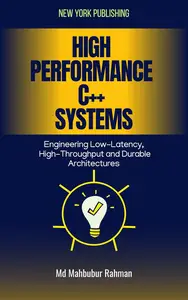
Free Download High-Performance C++ Systems: Engineering Low-Latency, High-Throughput, and Durable Architectures: Practical Techniques for High-Volume, Real-Time Applications by Md Mahbubur Rahman
English | August 16, 2025 | ISBN: N/A | ASIN: B0FMPWGFLB | PDF | 1.25 Mb
High-Performance C++ Systems: Engineering Low-Latency, High-Throughput, and Durable Architectures is a comprehensive guide for software engineers, system architects, and developers seeking to master the art of building scalable, high-performance C++ systems. In a world driven by real-time analytics, high-frequency trading, online gaming, IoT telemetry, and distributed streaming platforms, the demand for low-latency, high-throughput, and durable architectures has never been greater. This book provides the knowledge and practical guidance to design systems capable of processing hundreds of thousands of events per second without sacrificing reliability.
The book offers a practical approach to building high-throughput systems using modern C++ features and advanced programming techniques. Readers will explore concurrency, lock-free data structures, multithreading, coroutines, and asynchronous I/O, enabling them to achieve maximum throughput with minimal latency. Memory management techniques, including object pools, NUMA-aware allocation, and zero-copy serialization, are discussed in detail to ensure that systems remain efficient under extreme workloads.
Durability is a core focus of the book. It covers persistent storage solutions like RocksDB and LMDB, along with best practices for write-ahead logging, checkpointing, batching, and fault-tolerant recovery. Readers will learn how to maintain data integrity and strong durability guarantees even in the face of high event rates or system failures. The book also explores backpressure strategies, queue optimization, and batch processing, with C++ code examples demonstrating practical implementation.
A unique aspect of this book is its coverage of Rust integration for memory-safe components, allowing engineers to leverage zero-cost abstractions and security guarantees without compromising overall performance. It also includes advanced serialization techniques using FlatBuffers, Cap'n Proto, and Protocol Buffers to achieve fast, low-latency event transport, supporting both horizontal and vertical scaling of systems.
Performance monitoring and observability are emphasized throughout the book. Readers will learn to measure tail latency, throughput, CPU and memory usage, and queue depth, integrate real-time logging, distributed tracing, and metrics, and validate system performance through synthetic load tests and continuous benchmarking. Techniques for profiling, performance regression testing, and chaos engineering ensure that systems remain robust and predictable.
The book also addresses emerging hardware and future-proof designs, including persistent memory, GPUs, FPGAs, RDMA networking, and cloud-native architectures. It introduces AI-driven optimizations such as predictive scaling, adaptive backpressure, and anomaly detection, helping engineers design systems that adapt to variable workloads dynamically.
Practical appendices provide essential libraries, frameworks, and tools, including Boost.Lockfree, folly queues, RocksDB, spdlog, Google Test, and OpenTelemetry. A sample high-throughput C++ pipeline demonstrates end-to-end event ingestion, processing, and persistence, while a performance tuning checklist ensures engineers can optimize systems efficiently in production environments.
Whether you are a senior C++ developer, system architect, or engineering lead, High-Performance C++ Systems equips you with the skills to design robust, fast, and durable architectures.
Code:
Bitte
Anmelden
oder
Registrieren
um Code Inhalt zu sehen!