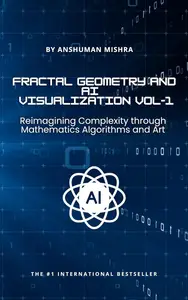
Free Download Fractal Geometry and AI Visualization: Reimagining Complexity through Mathematics, Algorithms and Art VOL-1 (AI & New Age Math) by Anshuman Mishra
English | November 6, 2025 | ISBN: N/A | ASIN: B0G16D7VW9 | 505 pages | EPUB | 0.46 Mb
Fractal Geometry and AI Visualization: Reimagining Complexity through Mathematics, Algorithms, and Art
Author: Anshuman Mishra, M.Tech (Computer Science), Assistant Professor, Doranda College, Ranchi
 Book Description
In an age where artificial intelligence has begun to shape not just industries but imagination itself, Fractal Geometry and AI Visualization stands at the intersection of mathematics, art, and intelligence - offering a transformative exploration of how self-similarity, chaos, and recursive structures underpin the emerging world of computational creativity.
This book is a deep academic yet visionary journey into the mathematical and conceptual beauty of fractals, and how these structures are inspiring next-generation AI models, image compression techniques, and generative art systems. Designed for students, researchers, and professionals, it bridges rigorous mathematical understanding with real-world applications in data science, visualization, and artificial intelligence.
1. The Essence of Fractals and the Digital Universe
Fractals are more than complex mathematical constructs - they are the fingerprints of nature. From the spiraling galaxies to the branching of trees, from the turbulent clouds to the neurons in our brains - fractal geometry governs the hidden order of apparent chaos.
But in the 21st century, fractals have moved beyond nature - they have become the backbone of artificial creativity. Neural networks, deep learning architectures, and AI-driven generative models now utilize fractal principles to create realistic patterns, compress information, and simulate natural systems.
This book begins by unveiling the foundational concepts of fractal geometry: self-similarity, iteration, scaling, and chaos theory. Readers are guided from the classical discoveries of Mandelbrot and Julia sets to the latest AI-based visual systems capable of reproducing infinite complexity from finite rules.
Every chapter is crafted to inspire understanding through clarity - blending mathematical derivations, algorithmic logic, and philosophical inquiry about how intelligence perceives and represents complexity.
2. Mathematical Foundations and Computational Models
Mathematics is the language of this universe, and fractals are its poetic expressions. The book dedicates early chapters to explaining how recursive equations, nonlinear dynamics, and iterative function systems (IFS) give rise to intricate, infinitely detailed structures.
It introduces the concept of fractal dimensions - where geometry expands beyond traditional Euclidean boundaries. You will explore:The Hausdorff dimension and its role in quantifying complexity.The Box-counting method as a bridge between theory and computational implementation.The power of chaotic attractors and recursive equations that generate endless diversity from simple rules.Mathematical rigor meets computational intuition, allowing readers to visualize the invisible - patterns of order arising from deterministic chaos. These principles are then extended to modern computational tools, explaining how Python, MATLAB, and deep learning frameworks can simulate and analyze fractal systems.
Code:
Bitte
Anmelden
oder
Registrieren
um Code Inhalt zu sehen!