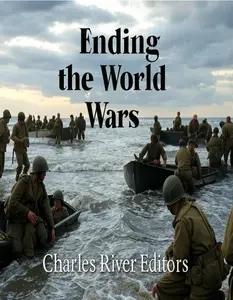
Free Download Ending the World Wars: The History of the Events and Battles that Finished World War I and World War II by Charles River Editors
English | September 17, 2025 | ISBN: N/A | ASIN: B0FRNSSJF7 | 530 pages | EPUB | 77 Mb
World War I, also known in its time as the "Great War" or the "War to End all Wars", was an unprecedented holocaust in terms of its sheer scale. Fought by men who hailed from all corners of the globe, it saw millions of soldiers do battle in brutal assaults of attrition which dragged on for months with little to no respite. Tens of millions of artillery shells and untold hundreds of millions of rifle and machine gun bullets were fired in a conflict that demonstrated man's capacity to kill each other on a heretofore unprecedented scale, and as always, such a war brought about technological innovation at a rate that made the boom of the Industrial Revolution seem stagnant.
For much of 1917, things went the Germans' way. With the Bolshevik Revolution underway, the Germans were able to move soldiers to the Western front as the Russians quit the war. Moreover, the Allied powers had failed badly in its Nivelle Offensive in May 1917 and suffered a defeat in November against at the Battle of Caporetto in Slovenia. Unbelievably, the French and British had not bothered to coordinate their commands until after those defeats: they finally formed a Supreme Council to coordinate their armies' movements and strategies.
Despite those successes, when the United States joined the war in April 1917, it began mobilizing 4 million soldiers to join the war. The Central Powers knew that it would take months before the United States could land a substantial number of troops in Europe to join the fighting, and the Germans hoped to force the Allied powers to quit before the United States could make a difference. Thus, the Germans' Spring Offensive began in March 1918, using new infantry tactics to move on the most lightly defended points of the Allied trenches. The Germans quickly obtained a breakthrough and broke the Allied lines, pushing the Allied forces back nearly 40 miles, and the Germans were once again within less than 100 miles of Paris. Once again, however, the Allied powers halted the Germans' drive, with the help of reinforcing American and Australian troops. The Germans were right back where they started by July 1918, at which time about 10,000 Americans were arriving in France each day.
During World War II, the free world literally hung in the balance, with the Axis and Allies engaging in warfare on an unprecedented scale. Although Hitler's Nazi Germany had overrun much of the European continent by 1940, the Allies began to reverse the momentum in 1942. By the end of 1943, with Allied forces firmly established in Italy and the Soviets on the verge of turning the tide in Russia, the British and Americans began to Description the invasion that would liberate Europe from the Nazis.
During the first half of 1944, the Americans and British commenced a massive buildup of men and resources in the United Kingdom, while Allied Supreme Commander Dwight D. Eisenhower and military brass planned the details of an enormous and complex amphibious invasion of Europe. Though the Allies used misinformation to try deceiving the Germans, the most obvious place for an invasion was just across the narrow English Channel, and the Germans had built coastal fortifications throughout France to protect against just such an invasion.
After the successful amphibious invasion on D-Day in June 1944, the Allies began racing east toward Germany and liberating France along the way. The Allies had landed along a 50 mile stretch of French coast, and despite suffering 8,000 casualties on D-Day, over 100,000 still began the march across the western portion of the continent. By the end of August 1944, the German Army in France was shattered, with 200,000 killed or wounded and a further 200,000 captured. However, Adolf Hitler reacted to the news of invasion with glee, figuring it would give the Germans a chance to destroy the Allied armies that had water to their backs.
Code:
Bitte
Anmelden
oder
Registrieren
um Code Inhalt zu sehen!