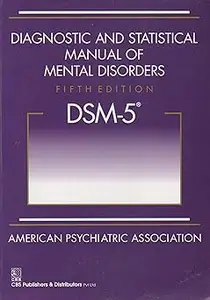
Free Download american psychiatric association committee on, "Diagnostic and Statistical Manual of Mental Disorders, 5th Edition: DSM-5"
English | ISBN: 9386217961 | 2017 | 991 pages | PDF | 68 MB
The American Psychiatric Association's Diagnostic and Statistical Manual of
Mental Disorders (DSM) is a classification of mental disorders with associated criteria designed to facilitate more reliable diagnoses of these disorders. With successive editions over the past 60 years, it has become a standard reference for clinical practice in the mental health field. Since a complete description of the underlying pathological processes is not possible for most mental disorders, it is important to emphasize that the current diagnostic criteria are the best available description of how mental disorders are expressed and can be recognized by trained clinicians. DSM is intended to serve as a practical, functional, and flexible guide for organizing information that can aid in the accurate diagnosis and treatment of mental disorders. It is a tool for clinicians, an essential educational resource . for students and practitioners, and a reference for researchers in the field.
Although this edition of DSM was designed first and foremost to be a useful guide to clinical practice, as an official nomenclature it must be applicable in a wide diversity of contexts. DSM has been used by clinicians and researchers from different orientations (biological, psychodynamic, cognitive, behavioral, interpersonal, family /systems), all of
whom strive for a common language to communicate the essential characteristics of mental disorders presented by their patients. The information is of value to all professionals associated with various aspects of mental health care, including psychiatrists, other physicians, psychologists, social workers, nurses, counselors, forensic and legal specialists, occupational and rehabilitation therapists, and other health professionals. The criteria are concise and explicit and intended to facilitate an objective assessment of symptom presentations in a variety of clinical settings-inpatient, outpatient, partial hospital, consultation-liaison, clinical, private practice, and primary care-as well in general community epidemiological studies of mental disorders. DSM-5 is also a tool for collecting and communicating accurate public health statistics on mental disorder morbidity and mortality rates. Finally, the criteria and corresponding text serve as a textbook for students early in their profession who need a structured way to understand and diagnose mental disorders as well as for seasoned professionals encountering rare disorders for the first time. Fortunately, all of these uses are mutually compatible.
Code:
Bitte
Anmelden
oder
Registrieren
um Code Inhalt zu sehen!